
Best API for coding: benchmarks and live prices

By Jay, CTO
· 12 min read

Pick the wrong API for your code generation project and you pay for it twice: once in dollars, once in debugging sessions. Claude Sonnet 4.6 and DeepSeek V4.1 Flash both handle code generation, but they differ by 19x in output token cost and excel at completely different task types.
This guide ranks the models available on Bearer Club by what they actually do well for coding workloads, with live member prices pulled directly from the catalog at bearer.club/models today, 2026-10-28.
Quick answer
- For complex multi-file reasoning and architecture: Claude Sonnet 5.5 at $9.50/1M output tokens (Member price, $10.00 list).
- For cost-sensitive or high-volume generation: DeepSeek V4.1 Flash at $0.757/1M output tokens or Qwen3 Coder 480B A35B at $0.85/1M output tokens.
- Bearer Club gives you one API key for all of these models. Swap between them by changing one string in your code, no new accounts or contracts needed.
A note on benchmarks: coding benchmark scores change every few weeks as new model versions ship. This guide quotes dated vendor-reported results and links the primary sources, so you can check what has changed since.
The best AI APIs for coding at a glance
The models developers reach for in coding work fall into three tiers by cost and capability. Claude Sonnet 5.5 and Claude Opus 5.5 are the usual picks for complex reasoning tasks like multi-file refactoring and architecture design. Qwen3 Coder 480B A35B and Devstral 2 2512 are purpose-built coding models with strong vendor-reported SWE-bench Verified results (sources below) at a fraction of the price. DeepSeek V4.1 Flash covers high-volume generation where cost dominates. All of these models are available through Bearer Club on one OpenAI-compatible endpoint, with member prices shown next to list prices in the catalog so you can see exactly what you save.
All prices below are Bearer Club Member tier, verified from bearer.club/models on 2026-10-28. "List price" is the provider's public list price. Context windows are the live values from the same catalog.
| Model | Context window | Member input price | Member output price | List output price | Best for |
|---|---|---|---|---|---|
| Claude Sonnet 5.5 | 1M | $1.90/1M | $9.50/1M | $10.00/1M | Complex reasoning, architecture |
| Claude Sonnet 4.6 | 1M | $2.85/1M | $14.25/1M | $15.00/1M | Balanced quality/cost |
| GPT-5.5 | 1.05M | $4.75/1M | $28.50/1M | $30.00/1M | General code, strong tool use |
| Devstral 2 2512 | 262K | $0.34/1M | $1.70/1M | $2.00/1M | Code-only tasks, fast iteration |
| Qwen3 Coder 480B A35B | 262K | $0.255/1M | $0.85/1M | $1.00/1M | Cost-sensitive code generation |
| Qwen3 Coder Next | 262K | $0.102/1M | $0.68/1M | $0.80/1M | Cheap code completion |
| DeepSeek V4 Pro 0423 | 1M | $0.812/1M | $1.62/1M | $1.91/1M | Budget reasoning + code |
| DeepSeek V4.1 Flash | 1M | $0.0202/1M | $0.757/1M | $0.891/1M | Ultra-high-volume generation |
Model IDs for Bearer Club: anthropic/claude-sonnet-5-5, anthropic/claude-sonnet-4-6, openai/gpt-5.5, mistral/devstral-2512, qwen/qwen3-coder, qwen/qwen3-coder-next, deepseek/deepseek-v4-pro, deepseek/deepseek-v4.1-flash.
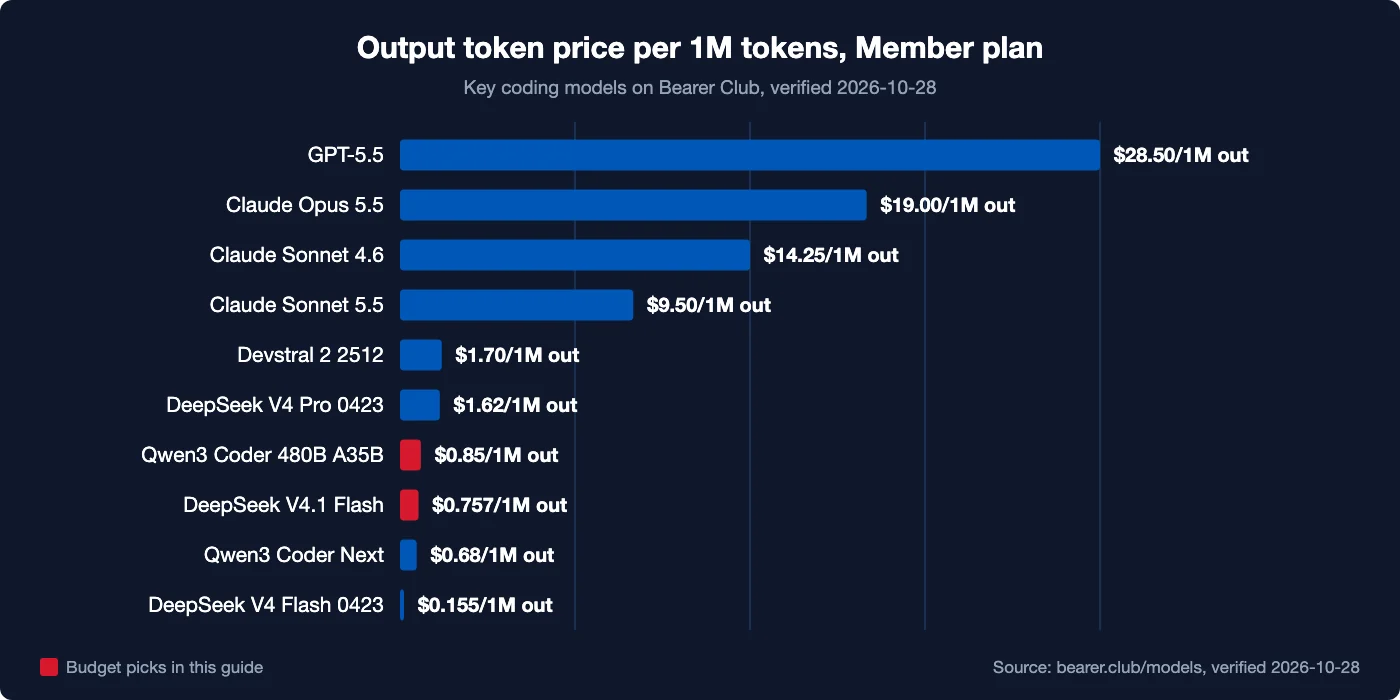
Bearer Club Member prices for output tokens across key coding models. Code generation is output-heavy, so this is the number that drives your actual bill.
Best model for complex coding and architecture
Claude Sonnet 5.5 is the current go-to for code tasks that require genuine reasoning: multi-file refactors, architecture decisions, understanding a poorly documented legacy codebase, or debugging a bug that only appears under specific runtime conditions. Its 1M-token context window lets you give it many files at once and get answers that account for how the files relate to each other.
Why Claude Sonnet 5.5 handles complex code well
Coding benchmarks measure different things. HumanEval tests function-level code synthesis. SWE-bench Verified tests the ability to resolve real GitHub issues across a full codebase. Terminal-Bench tests agentic work in a terminal. Anthropic's launch post for Claude Sonnet 5.5 reports 70.6% on Terminal-Bench 4.0 along with its other coding results (anthropic.com/claude-sonnet-5-5, September 2026). What you feel in practice: it reads an error message plus the surrounding 50 lines and gives you an explanation that doesn't require three follow-up questions.
In practice, the context window advantage matters most for debugging sessions longer than 30 minutes. Feed Claude the full file, the test output, and the error stack trace. You're more likely to get one accurate answer instead of several plausible ones.
Where it struggles
At $9.50 per million output tokens (Member price), Claude Sonnet 5.5 is expensive for high-volume tasks. If you're generating docstrings for thousands of functions or building a code autocomplete feature with thousands of calls per day, the cost adds up fast. That's what the budget tier is for.
What it costs through Bearer Club
Through Bearer Club, Claude Sonnet 5.5 costs $1.90 input and $9.50 output per million tokens on the Member plan, versus $2.00 and $10.00 at list price, a 5% saving at every call volume. The Executive plan brings it to $1.70 input and $8.50 output on a Private key, or $1.60 and $8.00 with Research Share (up to 20% off list for closed models). The current Executive price is in the bearer.club catalog.
Best model for fast, interactive code completion
Speed matters differently than quality for code completion. When a developer is waiting on a suggestion mid-keystroke, 300ms feels sluggish. When you're reviewing an architecture plan, waiting 5 seconds is fine.
What Qwen3 Coder Next delivers for completion tasks
Qwen3 Coder Next (qwen/qwen3-coder-next) is purpose-built for coding. It costs $0.68 per million output tokens at Bearer Club Member prices, versus $0.80 at list price (both verified from bearer.club/models on 2026-10-28). For a typical autocomplete call with 200 tokens of context in and 150 tokens of code out, that's $0.000144 per completion at list price, or $0.000122 at Member prices.
But if you're actually measuring latency rather than just cost, your server-side infrastructure and streaming setup will drive response time as much as the model will. Start with latency measurements on your actual workload before optimizing the model selection for speed.
DeepSeek V4.1 Flash for high-throughput completion
DeepSeek V4.1 Flash (deepseek/deepseek-v4.1-flash) costs $0.0202 input and $0.757 output per million tokens at Member prices. It's one of the lowest-cost options in the catalog that still handles code reasonably well. If you're building a service where users hit code generation hundreds of times per session, this is where to start. The DeepSeek API docs describe the model family's capabilities in detail.
Not every completion needs Claude-level reasoning. Docstring generation, variable renaming, and boilerplate scaffolding don't. Use the cheaper model for those and reserve the premium tier for the hard problems.
Best model for cost-sensitive projects and high-volume generation
For developers running large-scale code generation, Qwen3 Coder 480B A35B and DeepSeek V4.1 Flash are the two strongest options at Bearer Club. Qwen3 Coder 480B A35B (qwen/qwen3-coder) is a purpose-built coding model with a 262K context window at $0.255 per million input tokens and $0.85 per million output tokens on the Member plan, which is 15% below the $0.30/$1.00 list price. DeepSeek V4.1 Flash (deepseek/deepseek-v4.1-flash) goes further: $0.0202 input and $0.757 output per million tokens at Member prices, making it one of the lowest-cost coding options in the catalog. Both are available through Bearer Club on the same OpenAI-compatible endpoint as Claude and GPT, so switching between them requires changing one line of code.
The cost math at scale
If you're running 1,000 code generation tasks per day, averaging 2,000 input tokens and 500 output tokens each:
Qwen3 Coder 480B A35B through Bearer Club Member:
- Input: 1,000 × 2,000 × $0.255/1,000,000 = $0.51/day
- Output: 1,000 × 500 × $0.85/1,000,000 = $0.43/day
- Total: $0.94/day (vs $1.10/day at list price; 15% saving)
DeepSeek V4.1 Flash through Bearer Club Member:
- Input: 1,000 × 2,000 × $0.0202/1,000,000 = $0.04/day
- Output: 1,000 × 500 × $0.757/1,000,000 = $0.38/day
- Total: $0.42/day
At 1,000 calls per day, DeepSeek V4.1 Flash costs less than half of Qwen3 Coder. If you're running 10K calls per day, the gap becomes $4.19 versus $9.35. For a production API where code generation is a secondary feature, not the core product, that math justifies testing the cheaper model first.
Qwen3 Coder vs DeepSeek V4.1 Flash for real coding tasks
Qwen3 Coder models are specifically trained for code. Qwen reports state-of-the-art results among open models on SWE-bench Verified for Qwen3 Coder (Qwen blog, July 2025), and Mistral reports 72.2% on SWE-bench Verified for Devstral 2 (Mistral, December 2025). If your tasks are code-specific (generating a function from a docstring, completing a class method, translating between languages), Qwen3 Coder 480B A35B is likely the better call at a price that's still 11x cheaper than Claude Sonnet 5.5's output rate.
DeepSeek V4.1 Flash is a general-purpose model that handles code well rather than a model built specifically for code. For simpler code tasks (shorter functions, well-specified problems), the quality difference from Qwen3 Coder may not justify even the small cost difference. Benchmark them on your actual workload. You can try both in the free Bearer Club Playground before you spend credits. It covers open-weight models with short answers, and a Playground chat counts as use for the membership refund guarantee.
How to switch models without changing your code
Every model in the Bearer Club catalog runs on the same OpenAI-compatible endpoint: https://api.bearer.club/v1. You set that once when you create your client. After that, switching from Claude to DeepSeek to Qwen3 Coder is a single string change.
The one-line change that swaps models
Set up your client once:
from openai import OpenAIclient = OpenAI( base_url="https://api.bearer.club/v1", api_key="your-bearer-club-key", # one key for every model)Then pick your model by changing the model string:
# Complex architecture task: use Clauderesponse = client.chat.completions.create( model="anthropic/claude-sonnet-5-5", messages=[ {"role": "system", "content": "You are a senior software engineer."}, {"role": "user", "content": "Refactor this service to use dependency injection: ..."} ], max_tokens=2000,)# High-volume docstring generation: use Qwen3 Coderresponse = client.chat.completions.create( model="qwen/qwen3-coder", messages=[ {"role": "user", "content": "Write a docstring for this function: ..."} ], max_tokens=150,)# Ultra-cheap boilerplate: use DeepSeek Flashresponse = client.chat.completions.create( model="deepseek/deepseek-v4.1-flash", messages=[ {"role": "user", "content": "Generate a CRUD interface for this schema: ..."} ], max_tokens=800,)The base_url and api_key never change. The only difference is the model string. Bearer Club: one key, every model in the catalog, same call signature.
The docs page has copy-paste examples for curl and JavaScript if you're not using Python.
How to choose an API for your coding project
Most teams end up running two or three models rather than one. The choice isn't "which model is best"; it's "which model is right for which task type." Here's how to think about it.
Check Bearer Club's model catalog to compare current member prices against list prices before finalizing your model selection. Prices update when providers change their rates.
Cost as the deciding factor
If your cost-per-call budget is the primary constraint (you're building a product that bills per request, or your usage volume is high enough that token costs matter more than quality margins), start with DeepSeek V4.1 Flash or Qwen3 Coder Next. Both are under $0.001 per typical coding call at Member prices. Test them against your actual prompts before assuming quality is a problem.
In practice, teams often find they need premium-tier accuracy for a fraction of their actual calls once they test the budget models against real workloads.
Quality as the deciding factor
If you're building a coding assistant, agentic workflow, or code review tool where wrong answers cost real developer time, start at Claude Sonnet 5.5. Its stronger reasoning on hard, multi-file tasks is often worth the price premium for tools where the whole value proposition is accuracy.
A useful test: take 50 representative inputs from your actual use case. Run them through both a premium model and a budget model. Score the outputs manually. If the budget model passes 45 of 50, you don't need the premium model for that task type.
Context window considerations
Every model in the table above has a context window of at least 262K tokens, and Claude Sonnet 5.5, Claude Sonnet 4.6, GPT-5.5 and both DeepSeek models go to about 1 million tokens (live values on bearer.club/models). For most coding work, context size no longer decides between them.
What you pay for is the tokens you actually send: billing is per token, so a larger window only costs more when you fill it. Send the files and logs the task needs rather than the whole repository.
FAQ
Which AI API is best for code generation?
No single model leads on every coding task. Claude Sonnet 5.5 is a strong choice for complex architecture work and multi-file reasoning. For pure code generation volume at low cost, Qwen3 Coder 480B A35B and DeepSeek V4.1 Flash are good starting points. Both are available through Bearer Club at member prices without separate provider accounts.
What is the cheapest API for coding?
DeepSeek V4.1 Flash is one of the lowest-cost coding options on Bearer Club at $0.0202 per million input tokens and $0.757 per million output tokens (Member price). At 2,000 input and 500 output tokens per call, that's about $0.00042 per request. On raw price, DeepSeek V4 Flash 0423 is lower still, at $0.07735 input and $0.1547 output per million tokens. Qwen3 Coder Next costs a little more per typical call (its input price is higher, while its output price is lower at $0.68/1M) but is purpose-built for code and may produce better results on code-specific tasks.
Do I need a separate API key for each model?
Not with Bearer Club. You get one OpenAI-compatible API key that works for every model in the catalog (Claude, GPT, DeepSeek, Qwen, Gemini, Mistral, and more). You set the base_url to https://api.bearer.club/v1 once and switch models by changing the model string. One key, one bill, every model in the catalog.
Is my code safe with a third-party API service?
Bearer Club's Private key policy: prompts and outputs are stored encrypted for 30 days for security and abuse prevention, then deleted. They're never used for training and never shared or licensed. If you want lower prices in exchange for allowing your data to be used for AI research, you can opt into the Research Share policy. Full details are at bearer.club/legal/data-sharing.
How do I benchmark models for my specific coding use case?
Write a set of 20-50 test prompts that reflect your actual workload (function generation, bug fixing, docstrings, or whatever your primary task type is). Run each prompt through 3-4 candidate models and score the outputs on correctness and code quality. For more systematic benchmarking, LiveCodeBench and BigCodeBench document their methodology and publish scores on standardized code tasks (their leaderboards cover models released up to 2025). The free Bearer Club Playground lets you try open-weight models before you spend credits (a Playground chat counts as use for the membership refund guarantee).
Related posts
Bearer Club is not affiliated with or endorsed by any model provider. Model and provider names are trademarks of their respective owners.