
Replicate alternatives for developers watching token costs

By Jaya Muvania, Growth and SEO
· 12 min read

If you use Replicate to run open-weight models through an API, you have bumped into its friction points. Most community models bill per GPU second, not per token, so your cost depends on run time and hardware rather than on the tokens you generate. Replicate also runs official Claude, GPT and Gemini models priced per token, but every call goes through its own predictions API rather than the OpenAI format your code may already use.
There are now several well-established alternatives, each solving a different part of this problem. Some are model catalogs with per-token pricing. Some are GPU compute platforms. The right choice depends on whether you are running text inference or deploying custom model code.
Quick answer
- For LLM text inference with Claude, GPT, Llama and DeepSeek on one key: Bearer Club gives you 69 models through one OpenAI-compatible endpoint at member prices below list.
- For image generation or custom GPU pipelines: fal.ai and Modal are the right choice. Bearer Club does not offer GPU compute or custom model hosting.
- If your code already uses the OpenAI SDK, switching to Bearer Club takes two changes: set base_url to https://api.bearer.club/v1 and swap your API key, then use the provider/model ID from bearer.club/models.
Replicate alternatives at a glance
| Platform | Models | Billing | Closed LLMs | OpenAI-compatible |
|---|---|---|---|---|
| Bearer Club | 69 | Per token, member discount | Yes (Claude, GPT, Gemini) | Yes |
| Together AI | 100+ serverless | Per token | No | Yes |
| OpenRouter | 500+ | Per token + 5.5% card fee on credits | Yes | Yes |
| Fireworks AI | 400+ | Per token | No | Yes |
| fal.ai | 1,500+ media models | Per output or per GPU second | Through its LLM router | Partial |
| Modal | Any (self-hosted) | Per GPU second | No | Shared endpoints only |
| RunPod | Any (self-hosted) | Per second (shown hourly) | No | Partial |
| Replicate | Thousands | Per GPU second (community), per token (official models) | Yes (official models) | No |
Model counts from each provider's public pages, October 2026. Current Bearer Club catalog: bearer.club/models.
Why developers leave Replicate for text inference
Per-second GPU billing does not suit LLM workloads
Replicate's billing model works well for image generation tasks where each prediction has a fixed, short duration. For LLM text inference, it is harder to predict. Most community models on Replicate use per-second GPU pricing: $0.000225/second on a T4 GPU and $0.001400/second on an A100 (from replicate.com/pricing, verified 2026-10-28). A 70B-class community model generating 200 tokens might take several seconds depending on hardware allocation and queue time. At 10 seconds on an A100, that is $0.014 per call. At 1,000 calls a day, the bill varies with run time, not with your token count. Less-used community models can also take a while to cold-boot before generation begins. Per-token billing (what Bearer Club, Together AI, and OpenRouter all use) charges for the tokens you send and receive, regardless of hardware warm-up time.
In practice, GPU-second billing is unpredictable unless you benchmark your exact model and token mix first. For batch or async workloads that is manageable; for production serving where you want a stable cost-per-call, per-token billing is simpler.
Closed models sit behind a different API
Replicate's catalog of community-hosted and fine-tuned models is unmatched in breadth, and it also runs official Claude, GPT and Gemini models priced per token (see replicate.com/anthropic). What it does not offer is an OpenAI-compatible endpoint: calls go through Replicate's own predictions API. If your application is written against the OpenAI SDK, or you want closed and open-weight models on one key at prices below list, a multi-model API like Bearer Club or OpenRouter fits with fewer changes.
Bearer Club gives you closed and open-weight LLMs on one key
Bearer Club is a membership-based API that gives developers access to 69 models (including Claude Sonnet 5.5, GPT-6 Sol, Gemini 3.7 Flash, Llama 4 Maverick, DeepSeek V4 Flash, and Mistral Large 3) through a single OpenAI-compatible endpoint at https://api.bearer.club/v1. The Member plan ($199/year) prices tokens at a discount below each provider's list price. Llama 4 Maverick costs $0.1594 per million input tokens and $0.5546 per million output tokens on the Member plan, 15% below the $0.1875/$0.6525 list price. Claude Sonnet 5.5 is $1.90/$9.50 per million in/out tokens versus $2.00/$10.00 at list, a 5% discount. You point your existing OpenAI SDK at https://api.bearer.club/v1, swap the key, and all 69 models become accessible without changing your code structure. (Model count verified bearer.club/models, 2026-10-28.)
What it costs
Bearer Club has three membership tiers (verified bearer.club/pricing, 2026-10-28):
| Tier | Annual fee | Discount off list | Model access |
|---|---|---|---|
| Guest | Free | Up to 5% (Research Share required) | Open-weight only, with a yearly usage cap |
| Member | $199 | Up to 20% | All 69 models |
| Executive | $1,999 | Up to 30% | All 69 models |
Key LLM prices on the Member plan (verified bearer.club/models, 2026-10-28):
| Model | Provider | List in / out per 1M | Member in / out per 1M | Saving |
|---|---|---|---|---|
| Claude Sonnet 5.5 | Anthropic | $2.00 / $10.00 | $1.90 / $9.50 | 5% |
| Llama 4 Maverick | Meta | $0.1875 / $0.6525 | $0.1594 / $0.5546 | 15% |
| Llama 3.3 70B Instruct | Meta | $0.59 / $0.79 | $0.5015 / $0.6715 | 15% |
| DeepSeek V4 Flash | DeepSeek | $0.091 / $0.182 | $0.07735 / $0.1547 | 15% |
| DeepSeek V3.2 | DeepSeek | $0.259 / $0.80 | $0.2202 / $0.68 | 15% |
Running 10K Llama 4 Maverick summarization calls a day (500 input tokens, 200 output tokens average) costs $57.18/month on the Member plan versus $67.28 at list price, a 15% saving. No separate Meta or provider account needed, and it runs on the same key you use for Claude and everything else.
Data policy
Every Bearer Club API key has a data policy:
Private (default for Member and Executive): prompts and outputs are stored encrypted for 30 days, then deleted. They are never used for training and never shared or licensed.
Research Share (optional for Member and Executive, required for Guest): data may be licensed to AI labs for research after scrubbing for personal data and secrets. This is what lowers the price.
Full policy details are at bearer.club/legal/data-sharing.
What Bearer Club does not offer
Bearer Club is not a GPU platform. It does not support custom model deployments, fine-tuning, or image generation models. If you run FLUX or Stable Diffusion through Replicate, fal.ai or Modal is the right move, not Bearer Club. If the community model you rely on is not in the 69-model catalog, confirm that before switching. bearer.club/models lists everything available.
Together AI and its broad open-weight catalog
Strengths
Together AI serves 100+ open-weight models on its serverless API, including the DeepSeek, Kimi, Qwen, GLM and MiniMax families, with per-token billing and an OpenAI-compatible API. Its open-weight catalog is wider than Bearer Club's. Its Batch API runs selected serverless models at up to 50% off for non-time-sensitive jobs, which suits bulk processing or async workflows.
Limitations
Together AI does not serve Claude, GPT or Gemini chat models. If you need those alongside your open-weight models, you still manage separate accounts. Check together.ai/models for current per-token prices before comparing directly with the Bearer Club figures above.
Best for: teams running open-weight-only LLM workloads at volume who need a wider open-weight selection than Bearer Club's 69-model catalog.
OpenRouter with 500+ models and no upfront fee
When OpenRouter costs less than Bearer Club
OpenRouter charges a 5.5% fee when you buy credits by card ($0.80 minimum, per openrouter.ai/pricing) and has no annual membership. At low monthly spend, skipping a $199 yearly fee is usually the cheaper option.
When the membership pays off
Bearer Club's Member plan costs $199 a year and prices every model below the provider's list price: 5% below list on closed models and 15% below list on open-weight models with a Private key. The membership covers itself once those savings pass $199 a year, roughly $111 a month of open-weight usage or $332 a month of closed-model usage at list price (see the breakeven math below). Run the math for your specific model mix, and compare each service's per-model prices before choosing.
Best for: developers who want maximum model variety (500+ models from 80+ providers) without committing to an annual fee, or who keep monthly spend low.
fal.ai and Modal when you need the GPU itself
These two platforms solve a different problem than the per-token catalog services above. They give you GPU infrastructure, not just model access.
fal.ai
fal.ai specializes in media generation: FLUX image models, video generation, and audio inference, with fast cold starts. It lists 1,500+ image, video, audio and 3D models. If you use Replicate primarily for image or video workloads, fal.ai is the most direct replacement. Pricing is per generation or per GPU second for custom containers; current rates are at fal.ai/pricing.
Modal
Modal is Python-native serverless GPU infrastructure. You define your container and compute requirements in Python; Modal handles hardware allocation and scaling. If you run custom model code through Replicate's Cog framework, Modal is the closest equivalent. fal.ai also offers an OpenAI-compatible LLM router, and Modal offers OpenAI-compatible shared endpoints for a few open-weight models (see modal.com/products/inference), but their core products are media models and GPU compute.
Best for fal.ai: image and video generation workloads migrating off Replicate. Best for Modal: custom Python GPU pipelines, fine-tuning jobs, and bespoke inference handlers.
Browse Bearer Club's pricing tiers or the model catalog before deciding. If your models are in the catalog, switching takes under five minutes.
Cost at real usage volumes
How per-token compares to per-second billing
Replicate's per-second pricing for community LLMs is difficult to compare directly to per-token pricing because duration varies with model size, queue time, and prompt length. Replicate prices its official models per token (for example DeepSeek-R1 at $3.75/$10.00 per 1M in/out) and most community models per GPU second, so check replicate.com/pricing for the specific model you use. The table below shows Bearer Club Member prices alongside list prices:
| Model | Bearer Club Member (in / out per 1M) | List (in / out per 1M) |
|---|---|---|
| Claude Sonnet 5.5 | $1.90 / $9.50 | $2.00 / $10.00 |
| Llama 4 Maverick | $0.1594 / $0.5546 | $0.1875 / $0.6525 |
| Llama 3.3 70B Instruct | $0.5015 / $0.6715 | $0.59 / $0.79 |
| DeepSeek V4 Flash | $0.07735 / $0.1547 | $0.091 / $0.182 |
| DeepSeek V3.2 | $0.2202 / $0.68 | $0.259 / $0.80 |
Prices verified bearer.club/models and replicate.com/pricing, 2026-10-28.
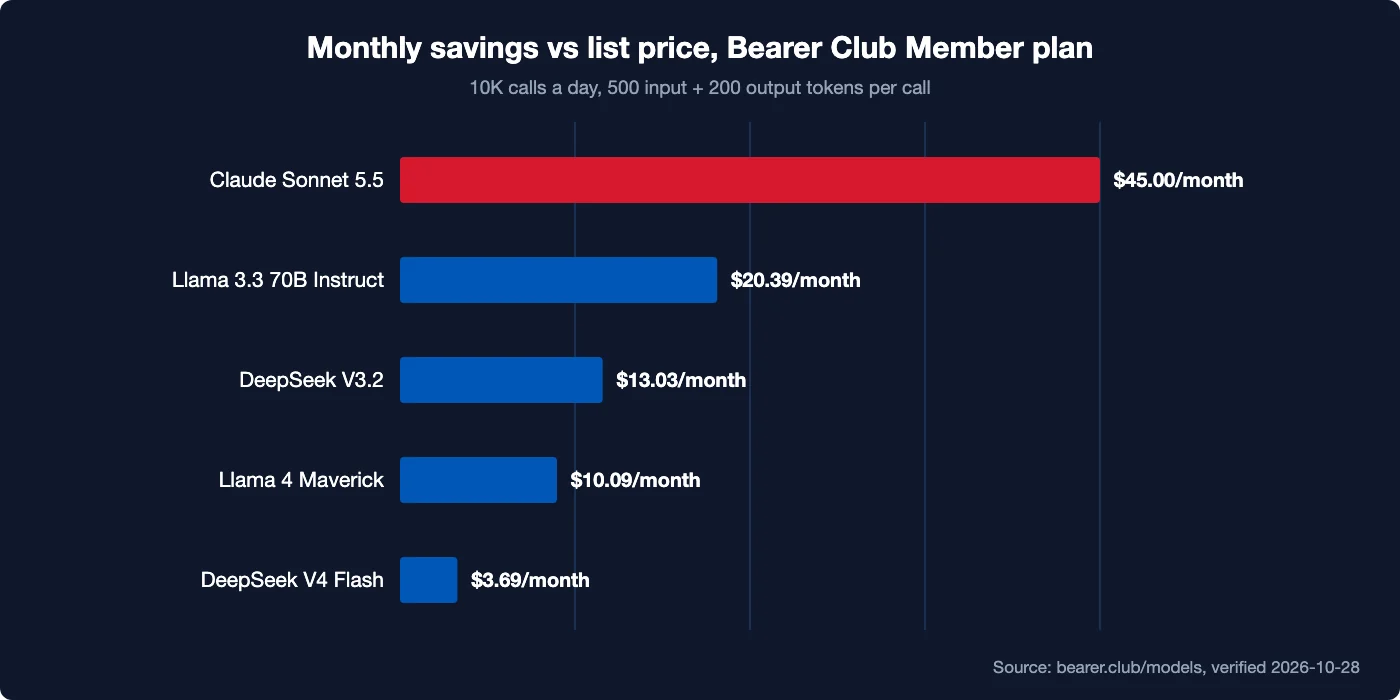
Claude Sonnet 5.5 saves the most in absolute dollars at 10K calls/day because the 5% discount applies to a higher absolute list price. Open-weight models save 15% but on lower base prices.
Bearer Club membership breakeven
At 15% savings on open-weight models (Llama, DeepSeek), the Member plan ($199/year = $16.58/month) pays for itself when your token spend on those models reaches about $111/month. At 5% savings on closed models like Claude Sonnet 5.5, the breakeven is around $332/month in Claude spend.
A mixed stack is faster to break even than either alone. Running 10K Llama 4 Maverick calls a day (500 in, 200 out) saves $10.09/month on tokens. Add a smaller Claude Sonnet 5.5 workload of 2,000 calls a day and you save an additional $9/month, about $19/month combined, covering the Member fee in under 11 months.
Switching to Bearer Club takes two lines
The Bearer Club API follows the OpenAI chat completions format. If you already use the OpenAI SDK, the migration is a base URL change, a key swap and the model ID. Calls written for Replicate's own predictions API move to the chat completions format shown below.
Python (OpenAI SDK)
from openai import OpenAIclient = OpenAI( base_url="https://api.bearer.club/v1", api_key="your-bearer-club-key", # create one at bearer.club/console/keys)response = client.chat.completions.create( model="meta-llama/llama-4-maverick", # model ID from bearer.club/models messages=[{"role": "user", "content": "Summarize this document: ..."}], max_tokens=500,)print(response.choices[0].message.content)Node.js (OpenAI SDK)
import OpenAI from "openai";const client = new OpenAI({ baseURL: "https://api.bearer.club/v1", apiKey: "your-bearer-club-key",});const response = await client.chat.completions.create({ model: "anthropic/claude-sonnet-5-5", // model ID from bearer.club/models messages: [{ role: "user", content: "Summarize this document: ..." }], max_tokens: 500,});console.log(response.choices[0].message.content);The model string takes the Bearer Club model ID. Copy it from the catalog at bearer.club/models. Streaming and message history work the same as in a standard OpenAI SDK call; tool calls, JSON mode and parameters such as temperature pass through where the model supports them.
Which should you use?
Choose Bearer Club if you need closed and open-weight models on one key
| Your situation | Best option | Reason |
|---|---|---|
| Need Claude or GPT alongside Llama | Bearer Club | Closed and open-weight models on one OpenAI-compatible key, below list price |
| Open-weight only, need wide catalog | Together AI | 100+ serverless models, per-token pricing |
| Max model variety, no upfront fee | OpenRouter | 500+ models, no annual fee (5.5% card fee on credits) |
| Latency-sensitive, high-concurrency LLMs | Fireworks AI | Serverless open-weight inference without cold starts |
| Image or video generation | fal.ai | Built for media, fast cold starts |
| Custom Python GPU code or fine-tuning | Modal | Python-native serverless GPU |
| Niche community models not in any catalog | Replicate | Thousands of community models |
| High volume, all model types | Bearer Club Executive | Up to 30% off list ($1,999/year) |
Choose something else if you need GPU compute
Bearer Club is the wrong tool for custom model deployment, fine-tuning, or image generation. It is a model catalog, not a compute platform. When you need hardware control or a model outside the 69-model catalog, one of the other platforms above fits better.
FAQ
What is the main difference between Replicate and Bearer Club?
Replicate hosts thousands of community models (Stable Diffusion variants, custom fine-tunes, audio models) and bills most of them per GPU second; its official models, including Claude, GPT and Gemini, are priced per token on its own API. It is a compute platform where community members deploy and run model code. Bearer Club is a membership that gives access to 69 chat models, including closed models like Claude, GPT, and Gemini, through one OpenAI-compatible key at member prices below list. Bearer Club does not support custom model deployment.
Does Bearer Club have Llama models?
Yes. The catalog includes Llama 4 Maverick (meta-llama/llama-4-maverick) and Llama 3.3 70B Instruct (meta/llama-3.3-70b-instruct). Member pricing on Llama 4 Maverick is $0.1594 per million input tokens and $0.5546 per million output tokens, 15% below the $0.1875/$0.6525 list price (verified bearer.club/models, 2026-10-28).
Is Bearer Club cheaper than Replicate for LLM inference?
For per-token billing: Bearer Club's Member plan prices are 5-20% below provider list prices depending on the model and data policy. Replicate prices its official models per token and most community models per GPU second, so compare the specific model you use on replicate.com/pricing.
Can I use my existing OpenAI SDK code with Bearer Club?
Yes. Set base_url to https://api.bearer.club/v1 and replace your API key. The Bearer Club API uses the OpenAI chat completions format for all 69 models. Streaming and message history work on every model; tool calls and JSON mode pass through where the model supports them. The only changes are the base URL, the key and the model ID.
What happens to my API data with Bearer Club?
Private keys (default for Member and Executive): content is stored encrypted for 30 days, then permanently deleted. It is never used for model training and never shared. Research Share keys (optional for Member and Executive, required for Guest): data may be licensed to AI labs for research after scrubbing for personal data and secrets. The data policy applies per key, not per account. Details at bearer.club/legal/data-sharing.
Is there a free tier?
The Guest plan is free and gives access to open-weight models. It requires the Research Share data policy. The Bearer Club Playground at bearer.club/playground is also free with a sign-in, rate-limited, and covers open-weight models; a Playground chat counts as use for the membership refund guarantee. The Member plan is $199/year and includes all 69 models with the Private data policy as the default.
Related posts
Bearer Club is not affiliated with or endorsed by any model provider. Model and provider names are trademarks of their respective owners.