
OpenRouter alternatives ranked by price and model access

By Minghao, Co-founder
· 11 min read

OpenRouter gives you one API key for hundreds of models. That's the pitch, and it holds up: the catalog is genuinely wide and the integration is a single base URL change. But the way it prices things has a detail worth understanding before you commit.
When you buy credits on OpenRouter by card, you pay a 5.5% platform fee ($0.80 minimum). That fee is on the credit purchase, not on individual requests. At small scale it's noise. At 10K Claude Sonnet calls a day, it adds up to real money. On the Business plan it's 8%.
This post covers six services that give you multi-model access through a single OpenAI-compatible key. Bearer Club is our recommendation for teams watching per-token costs. The others win in different situations. I'll tell you which is which, and I'll use current prices rather than rough percentages.
Quick answer
- Bearer Club's $199/year Member plan gives you 69 models at 5-20% below list price with no fee on credit purchases. For teams running popular closed models at real volume, that usually costs less than paying list price plus OpenRouter's 5.5% card fee.
- OpenRouter has 500+ models and no membership requirement. It wins on breadth and for small-scale or one-off use.
- Together AI and Fireworks AI are direct inference providers, not aggregators; they suit fine-tuning or guaranteed throughput on a single open-weight model.
OpenRouter and its main alternatives at a glance
Six services compete for the "one key, many models" use case. They're not interchangeable. Model breadth, pricing mechanics, and data policy all differ enough to matter.
| Service | Model count | Pricing model | OpenAI-compatible | Standout feature |
|---|---|---|---|---|
| Bearer Club | 69 | Membership ($199/yr) + credits at member price | Yes | 5-20% below list on every call |
| OpenRouter | 500+ | Pay-as-you-go, 5.5% card fee on credit purchases | Yes | Largest multi-provider catalog |
| Together AI | 100+ serverless | Pay-as-you-go per token, no membership | Yes | Fine-tuning and dedicated endpoints |
| Fireworks AI | 400+ | Prepaid credits, per token, no membership | Yes | SOC 2 / ISO 27001, serverless without cold starts |
| LiteLLM | 100+ LLMs | Free and self-hosted; paid Enterprise tier | Yes | Run inside your own VPC |
| Cloudflare AI Gateway | 20+ native providers | Free core features, bring your own key | Yes | Edge caching, observability, BYOK |
Live model counts change frequently. The Bearer Club catalog is at bearer.club/models (count verified 2026-10-28).
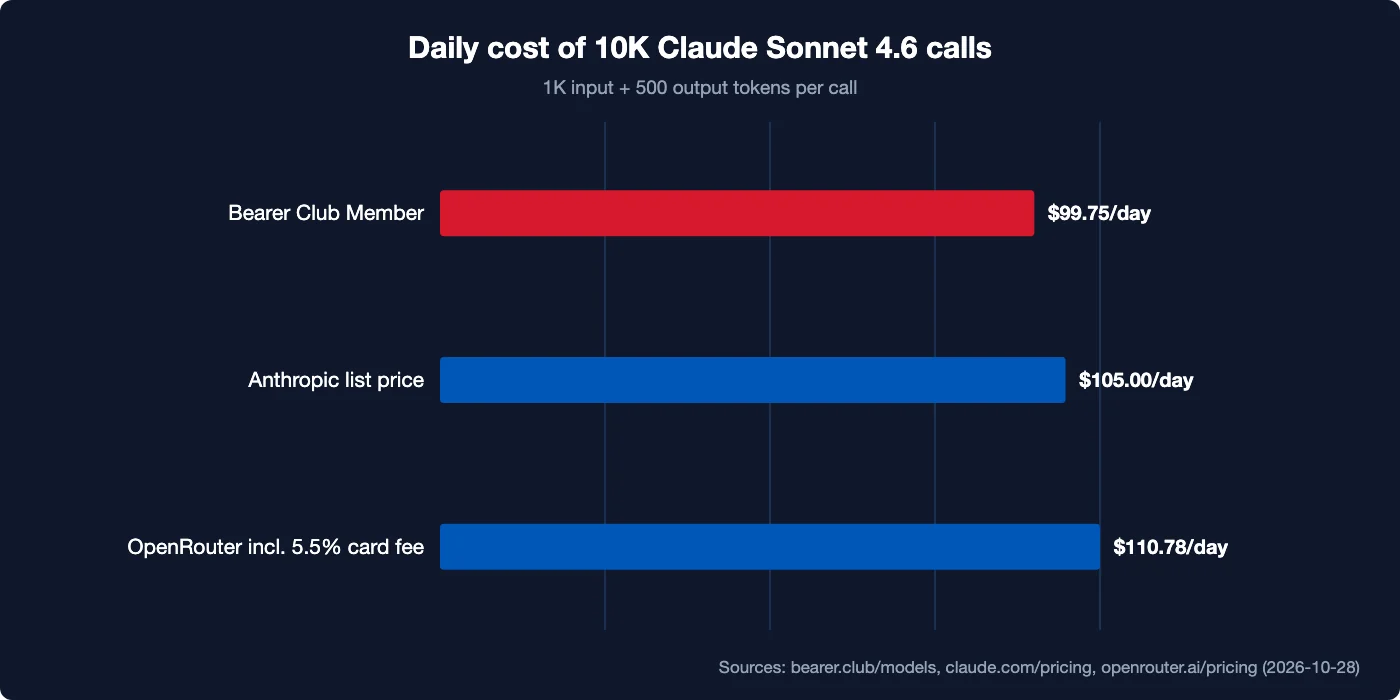
At 10K Claude Sonnet 4.6 calls per day (1K input + 500 output tokens each), Bearer Club's Member plan costs $99.75 versus about $110.78 through OpenRouter once its 5.5% card fee is included: about 10% less, a gap that compounds with scale.
Bearer Club for cost-conscious teams
Bearer Club is a membership service for AI APIs. Pay $199 a year for the Member plan and you get 69 models through one OpenAI-compatible endpoint (https://api.bearer.club/v1). Every API call is billed at a fixed percentage of the provider's published list price: closed models (Claude, GPT, Gemini) at 5-10% below list depending on data policy, open-weight models at 15-20% below list. No platform fee on credit purchases. The model catalog shows the list price and the member price side by side so you can verify the saving for every model before you commit. The analogy is a warehouse club: pay once to join, then pay member prices on every purchase for the rest of the year.
How it works
Point any OpenAI SDK at https://api.bearer.club/v1 and use your Bearer Club API key. Model IDs use a provider/model format, such as anthropic/claude-sonnet-4-6; copy the exact ID from bearer.club/models. No separate provider accounts, no separate billing, no separate keys.
That's the integration. One account, one key, one bill.
What you pay as a Member
Here's the catalog pricing for the Claude models most teams actually use (Bearer Club prices verified from bearer.club/models on 2026-10-28; list prices are Anthropic's published prices at claude.com/pricing):
| Model | Anthropic list price (input / output per 1M) | Member (Private) | Member (Research Share) |
|---|---|---|---|
| Claude Sonnet 4.6 | $3.00 / $15.00 | $2.85 / $14.25 | $2.70 / $13.50 |
| Claude Sonnet 5.5 | $2.00 / $10.00 | $1.90 / $9.50 | $1.80 / $9.00 |
| Claude Haiku 4.5 | $1.00 / $5.00 | $0.95 / $4.75 | $0.90 / $4.50 |
| Claude Opus 4.8 | $5.00 / $25.00 | $4.75 / $23.75 | $4.50 / $22.50 |
Private is the default policy for Member accounts. Research Share means your data may be licensed to AI labs for research after scrubbing; it's opt-in and lowers the price further.
If you're running Claude Sonnet 4.6 at 10K calls a day with 1,000 input tokens and 500 output tokens per call, Bearer Club's Member plan costs $99.75 per day versus $105.00 at Anthropic's list price. That's $5.25 a day, $1,916 a year in savings from member pricing alone. The $199 membership fee covers itself in about 38 days at that call volume.
Open-weight models save more: 15% off list on a Private key and 20% with Research Share.
See full membership tiers and pricing →
Honest limitations
Bearer Club has 69 models. OpenRouter has 500+. If your project depends on a very recent or niche model, check the catalog before assuming it's there. Bearer Club launched in October 2026, so the catalog is growing, and models that aren't there yet may appear in the coming months.
Guest accounts are free but limited to open-weight models and require the Research Share data policy. The $199/year Member plan adds access to closed models (Claude, GPT, Gemini) and the Private data policy.
Bearer Club does not publish an SLA, an uptime commitment or compliance certifications yet. If your compliance team requires a certified provider, Bearer Club is not there yet.
OpenRouter for developers who need more models
OpenRouter is the aggregator with the widest catalog: it lists 500+ models from 80+ providers, and the count keeps growing. For teams experimenting with many providers or working with niche models that aren't in other catalogs, that breadth is genuinely useful.
What OpenRouter costs
OpenRouter says it passes through the pricing of the underlying model providers without markup (OpenRouter FAQ). The fee is a percentage of your credit purchase (openrouter.ai/pricing, checked 2026-10-28):
- Card purchases: 5.5% on credit top-ups ($0.80 minimum); 5% for crypto
- Business plan: 8% on credit top-ups
- BYOK (bring your own key): free up to $25,000/month of list-price inference, then 5% above that
OpenRouter lists Claude Sonnet 4.6 at $3 / $15 per million tokens, the same as Anthropic's own price. With the 5.5% card fee on the credits that pay for it, the same 10K-calls-a-day workload costs about $110.78 a day, versus $99.75 on Bearer Club's Member plan: about 10% less.
One notable fact: in August 2026, Stripe announced an agreement to acquire OpenRouter (Stripe newsroom). It's unclear how that will affect the pricing model or roadmap. Worth keeping an eye on.
When OpenRouter wins
If you need a model that isn't in Bearer Club's 69-model catalog, OpenRouter is the straightforward answer. The free :free model variants (rate-limited but zero cost) are also useful for early prototyping. And if you're not running significant volume, the 5.5% card fee is genuinely not worth worrying about.
Together AI for open-weight fine-tuning
Together AI runs inference for its own catalog rather than offering many providers' models on one key.
Their serverless catalog runs to 100+ open-weight models, including DeepSeek V4, Kimi K3, Qwen, GLM, MiniMax, and others. No Claude, GPT or Gemini chat models. Pricing is pay-as-you-go per token with no membership fee.
What makes Together AI worth considering over OpenRouter is the fine-tuning pipeline. They support LoRA and full fine-tuning on their hosted infrastructure, and the training API sits alongside the inference endpoint. If your workflow involves training a custom version of Llama or DeepSeek on your own data, Together's integrated setup avoids moving data between services.
They also offer dedicated endpoints with guaranteed throughput, which matter once you've moved past prototyping and need consistent response times. Together AI is not a substitute for Bearer Club or OpenRouter if you need Claude, GPT, or Gemini. It's the right choice when you're all-in on open-weight models and fine-tuning is part of the plan.
Fireworks AI for low-latency inference
Fireworks AI runs serverless and dedicated inference for open-weight models. No membership fee. Billing uses prepaid credits drawn down by token usage.
The clearest differentiator is compliance. Fireworks holds SOC 2 Type 2, ISO 27001, ISO 27701, and ISO 42001 certifications. Bearer Club has not published equivalent certifications yet, and OpenRouter lists SOC 2 Type II on its enterprise page. If your organization requires a certified provider, Fireworks is a serious option for open-weight workloads.
Fireworks also runs serverless inference without cold starts. First-request latency is consistent, not spiking on idle containers. For chatbots, coding assistants, and voice applications, that's a real distinction from providers where the first request to a cold endpoint takes seconds.
Like Together AI, Fireworks does not host closed models (its Nexus Auto router can call Claude or GPT on your own Anthropic or OpenAI account). Bearer Club or OpenRouter is still the simpler route if your stack uses Claude, GPT, or Gemini alongside open-weight models.
How to switch from OpenRouter to Bearer Club
Switching from OpenRouter to Bearer Club is a two-line change in your existing code, plus the model ID. Both services use the OpenAI client with a custom base_url. Bearer Club model IDs use a provider/model format (for example anthropic/claude-sonnet-4-6), so copy the exact ID from bearer.club/models when you switch. Change the base URL to https://api.bearer.club/v1 and replace your OpenRouter key with your Bearer Club key. No other changes to request structure are required.
Step 1. Get your Bearer Club key
Sign up at bearer.club and choose a membership tier. The console shows your balance, usage, and the member price next to the list price for every model. Generate an API key and choose a data policy: Private (default) or Research Share (lower price, prompts may be licensed for research after scrubbing).
Step 2. Change two lines
from openai import OpenAIclient = OpenAI( base_url="https://api.bearer.club/v1", # was: https://openrouter.ai/api/v1 api_key="your-bearer-club-key", # was: your OpenRouter key)response = client.chat.completions.create( model="anthropic/claude-sonnet-4-6", # Bearer Club model ID from bearer.club/models messages=[{"role": "user", "content": "Hello"}],)print(response.choices[0].message.content)The same swap works in Node.js, Go, or curl. Tools like Cursor, Cline, and LiteLLM that let you set a custom OpenAI-compatible base URL work the same way.
Want to try a model before using API credits? The free Playground at bearer.club lets you send requests to open-weight models without touching your balance; a Playground chat counts as use for the membership refund guarantee. The docs have copy-paste examples for curl, Python and JavaScript.
Which service fits your project?
These services aren't all competing for the same use case. The right call depends on what you actually need.
| Main need | Service | Reason |
|---|---|---|
| Lower cost on popular closed models (Claude, GPT) at volume | Bearer Club Member | 5-10% below list on closed models, no credit purchase fee |
| Largest possible model catalog | OpenRouter | 500+ models, free tier variants |
| Fine-tuning open-weight models | Together AI | Integrated training + inference, dedicated endpoints |
| Low latency with compliance certifications | Fireworks AI | SOC 2, ISO 27001, no cold starts on serverless |
| Self-hosted, no third party | LiteLLM | Free, runs inside your VPC |
| Observability and edge caching, bring your own key | Cloudflare AI Gateway | No per-token fee when BYOK |
In practice, many teams use two. Bearer Club for Claude and GPT at volume, and Together AI or Fireworks for fine-tuned open-weight models on the side. The use cases don't really overlap. Use closed models for quality-critical tasks, open-weight models for high-volume or custom-trained workloads.
FAQ
What is the difference between OpenRouter and Bearer Club?
OpenRouter routes to 500+ models with no membership requirement and no per-token markup, but charges a 5.5% fee on card credit purchases. Bearer Club has 69 models and charges a $199/year membership that gives you 5-20% off every call. Bearer Club's net economics are better once you're running meaningful volume on popular models. OpenRouter is better when you need models outside Bearer Club's catalog or want no upfront commitment.
Does OpenRouter mark up token prices?
OpenRouter says it passes through the underlying providers' pricing without markup. Its revenue comes from fees on credit purchases: 5.5% by card ($0.80 minimum) and 8% on the Business plan. Bring-your-own-key (BYOK) users get $25,000/month of list-price inference without fees, then pay 5% on the excess.
Is Bearer Club's Research Share data policy safe for sensitive prompts?
Research Share means your data may be licensed to AI labs for research after being scrubbed for personal information and secrets. For sensitive production prompts, use the Private policy. Private keys have content stored encrypted for 30 days for security and debugging, then deleted; they're never used for training or shared. The full policy is at bearer.club/legal/data-sharing.
Can I use Bearer Club with Cursor, Cline, or LiteLLM?
Yes. Any tool that lets you set a custom OpenAI-compatible base URL works with Bearer Club. Set https://api.bearer.club/v1 as the base URL and use your Bearer Club API key. Most coding agents have a settings field or .env variable for this.
Does Together AI or Fireworks AI carry Claude or GPT?
Neither hosts Claude or GPT chat models. Together AI serves open-weight chat models (plus some closed image and video models), and Fireworks hosts open models only. For Claude, GPT or Gemini on one key, use a multi-model API like Bearer Club or OpenRouter.
How many models does Bearer Club have?
69, verified from bearer.club/models on 2026-10-28. The catalog is growing; check the live page for the current count.
Related posts
Bearer Club is not affiliated with or endorsed by any model provider. Model and provider names are trademarks of their respective owners.